You don’t need a massive bankroll to spend two weeks eating world-class pepper crabs by the Kampot River or the seaside of Kep. If you are sick of the chaotic 24/7 grind and want a realistic, budget-friendly blueprint of what a southern Cambodian loop costs, look no further. My journey from Siem Reap down to the coast on a budget comes complete with prices, guesthouse reviews, and the transport options that will either save your wallet or break your back. All prices are current as of June 2026.
Phnom Penh: A Whirlwind Pitstop
Phnom Penh Royal Palace
My journey down south began with a quick, one-night stop in Phnom Penh, a capital city that never stops moving.
The Base: I checked into the Ray Apartments and Hotel. It served as an excellent, highly comfortable base to regroup left-handed after the long road down. It was $19 a night and absolutely lovely, worth every cent. It’s close enough to walk to the main attractions in downtown Phnom Penh but still on a quiet street with some great restaurants.
The Watering Hole: Eager to see the riverfront, I headed straight for the Oz Bar. It is a safe and friendly spot for solo women travelers right on the water to grab an ice-cold drink, catch the evening breeze, and watch the endless parade of boats and people pass by.
The Feed: When dinnertime rolled around, I bypassed the regular tourist restaurants and went straight to the Phnom Penh Night Market. Eating here is an absolute must-do. You buy your food straight from the smoky stalls, everything from grilled meats on skewers to fresh noodles, and then you kick off your shoes and sit on the large woven mats spread across the floor. It is communal, loud, and entirely local.
The Changing Rooflines of Cambodia
As the train rolled out of the capital and headed deep into the southern provinces, the landscape didn’t just change; the traditional Khmer architecture shifted too. If you keep your eyes locked on the countryside through the train windows, you will notice a distinct regional border line drawn right across the rooflines:
The Siem Reap Baseline: Up north in Siem Reap, the traditional wooden homes are famously double-fronted. They feature two distinct, parallel roof ridges, built side-by-side, giving the homes a wide, heavy, double frontage. The style reminds me of my childhood home in the country of Australia.
The Southern Shift: The moment you cross into the southern provinces toward Kampot and Kep, the double-fronts become less common. Instead, the homes flip into long, elegant rectangles with the massive, expansive front wall facing straight toward the road or river.
The Roof Finials: The real magic is in the details. These southern roofs are topped with striking, decorative wooden finials (chofa) piercing the sky at both ends of the roofline, often with a third, majestic central finial crowning the absolute middle of the ridge. It is a stunning, localized architectural signature that captures the slow, artistic pace of the coast.
Quick Tip for the Rainy Season: If you travel during the monsoon months, do not let the afternoon downpours scare you. The rain typically arrives at a predictable time. They are heavy, intense, and loud, but they blow over in an hour or two. Simply carry a lightweight poncho, seek refuge in a cozy café or bar, and observe the streets transform into rivers before the sun reemerges.
Kampot: Rivers, Statues, and Total Relaxation
kampot thing to do
In the chaotic energy of the capital, I made my way to Kampot. The town has a remarkably laid-back, local vibe and beautiful, quirky French colonial architecture that feels completely frozen in time. I originally booked only two nights here, but I fell so completely in love with the town’s pace that I stayed for almost two weeks!
The Guesthouse Battle ($15/Night)
I tested out two different budget spots right on or near the riverfront, and they each have distinct tradeoffs:
Twin House Guesthouse: For just $15 a night, it sits right on the water and is steps from fantastic restaurants and bars. There is no elevator, but you get a handy fridge in your room to keep your drinks cold.
Sosadai Guesthouse: Also $15 a night. You get a massive room and a wonderful elevator that helps reduce strain on your joints, but the room does not include a fridge. It’s a few blocks back from the river.
The Quirky Roundabouts and Local Art
Kampot is full of wonderful little quirks and landmark statues that every expat and local uses to navigate the town. You cannot miss them:
The Giant Durian Statue: The ultimate, pungent roundabout landmark.
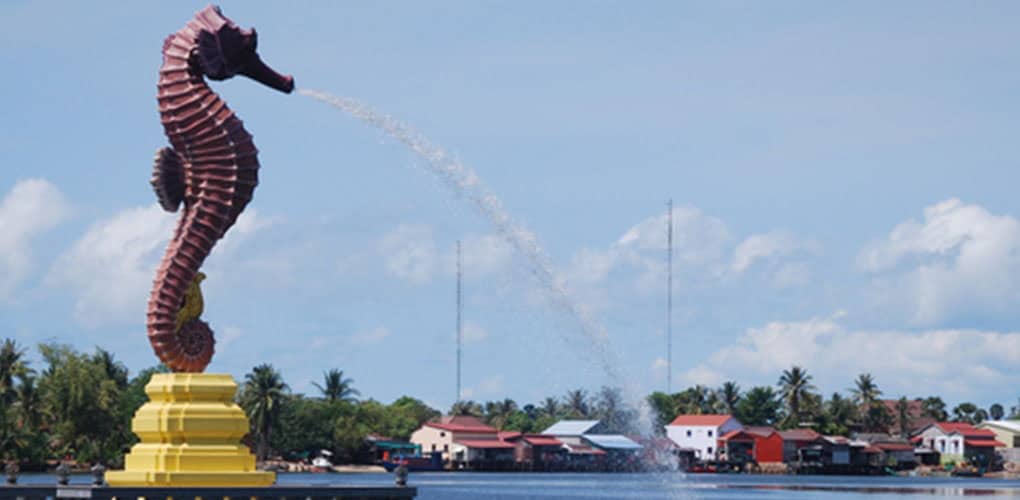
The Seahorse Statue: Mystically spitting water into the river with a massive clock standing right behind it.
The 2000s Sign: A giant, nostalgic monument on another major roundabout.
The Riverfront Mini-Cars: Every evening, the riverfront comes alive as local kids drive around in tiny, brightly lit toy cars while families sit nearby and chat in the cool air.
Shopping Note: The retail scene here is delightfully unique. You can spend hours browsing the second-hand bookshop and local markets and picking up gorgeous handmade homewares and clothes at Kampot Tiny Pillows. I couldn’t resist a couple of cool stubby holders featuring 1920s art in Kampot and Phnom Penh. There’s even a creative hair salon housed entirely inside a metal shipping container. The 1920s shophouses and giant trees that still line the streets give Kampot a lovely, laid-back vibe.
The Local Watering Holes
The food and drink scene here is low-key but world-class, packed with excellent menus at fantastic local prices. Three spots quickly became my daily haunts:
The Pig Pen: A wonderful riverfront bar where we managed to make fast friends with the lovely owners on day one through an accidental community mission. Their gorgeous resident dog, Pepper, who looks exactly like a wild Australian dingo, managed to sneak out and head off on an unauthorized solo walk through town. My friend and I jumped into action to help track him down and bring him safely back to base, making us all friends at once. Expect to spend about $5–$10 for a fantastic feed and excellent hospitality.
Mate’s Place: An incredibly welcoming sports bar hangout. It is the perfect place to watch a game or strike up a lively chat over the counter. Prices range from $1–$15.
Rusty Key: A relaxed, low-key sports bar with an incredibly friendly atmosphere and delicious comfort food in the $5–$10 bracket.
Day Trip: The Mist of Bokor Mountain (Budget: $5–$10 for Moto or $30 for a Tuk-Tuk)
If you want a complete break from the tropical heat, rent a semi-automatic scooter for about $5 to $7 a day (plus fuel) or hire a local tuk-tuk driver for around $30 to tackle the winding, 32-kilometer climb up Bokor Mountain.
Warning: Bring a jumper or jacket! The temperature plummets dramatically as you climb to the altitude. When I reached the top, upon reaching the summit, a thick, freezing, moody fog enveloped me, covering the entire plateau. Upon reaching the summit, I was enveloped by a thick, freezing, moody fog that covered the entire plateau. A thick, freezing, moody fog swallowed the entire plateau when I reached the top. by a thick, freezing, moody fog. I photographed the historic, abandoned 1920s French Catholic stone church up there, and when I showed it to people later, no one believed it was Cambodia. The heavy mist, gray stone, and atmospheric chill looked exactly like the rugged coast of Ireland. It is an absolute must-see.
Local Industry Spotlight: The Shimmering Salt Fields of Kampot
While Kampot’s world-famous pepper gets all the international culinary glory, the region holds a second, massive claim to fame: it is the literal salt basket of Cambodia. Just 15 minutes outside the center of town on the coastal road connecting Kampot to Kep lies a mesmerizing, mirror-flat landscape of large sea salt pans.
The Visual Kaleidoscope: If you look down at the plains from the high cliffs of Bokor Mountain on a clear day, the vast salt pans don’t just look white; they shimmer in a brilliant patchwork of pinks, deep browns, and dazzling silvers. This stunning phenomenon is caused by the varying levels of water evaporation and the presence of natural, salt-loving micro-algae (like Dunaliella salina) that shift colors as the briny sea water concentrates under the sun.
The Artisanal Process: This isn’t industrial chemical processing; it is pure, artisanal organic heritage managed by local families using traditional wooden tools. Every year in December, pristine seawater from the Gulf of Thailand is allowed to flow into shallow, clay-lined fields. The intense tropical sun and coastal breeze slowly evaporate the liquid over several days.
The Harvest: Once the water evaporates, workers walk onto the flat pans at dawn to manually rake the sparkling, coarse white crystals into neat, uniform triangular pyramids, which are then carried away in wicker baskets to massive wooden drying sheds lining the fields.
The High-End Luxury (Fleur de Sel): If you visit during the peak hot months of April and May when there is absolutely no wind, you can see the harvest of Kampot fleur de sel (flower of salt). This product is an ultra-rare culinary delicacy where the delicate, sweet, mineral-rich salt crystals gently skim the very surface of the water. It is dual-certified alongside Kampot pepper, containing over 80 natural trace minerals that give it a crunchy, complex flavor profile that world-class chefs pay top dollar for.
Excursion: The Holy Trinity of Kampot Pepper (Budget: Free to Tour, $5–$10 for Souvenir Packs)
You cannot visit Kampot without heading out to a local organic pepper plantation (like La Plantation or Sothy’s). Kampot pepper holds a protected geographical indication (GI) status, the same elite legal protection given to Champagne in France, and it is widely regarded by world-class chefs as the best pepper on earth. When you take a free guided walking tour through the shaded vine fields, you will get to taste the distinct flavor profiles of the three primary varieties harvested from the exact same plant:
Black Pepper: Harvested when the berries are green and dried under the intense sun, delivering a sharp, intense, fiery heat with a deep floral undertone.
White Pepper: Made from fully ripe red berries that are soaked in water to remove the outer skin, leaving a smooth, earthy, and refined peppery bite.
Red Pepper: The absolute crown jewel. Left on the vine until it turns a vibrant crimson, it carries a unique, complex sweetness with fruity notes of citrus and tobacco. I fell so completely in love with the red variety that I bought a stash of both red and black pepper to bring straight back home to my kitchen.
Kep: Children’s Smiles and “Choul Moi!”
A short trip in a tuk tuk ($20) down the coastal road brought me to Kep, a sleepy seaside town that feels wonderfully quiet at night. In fact, after about 5:00 PM, the whole town shuts down so completely you will probably only find one solitary tuk-tuk driver left in the whole province!
The Stay: I stayed just 100 meters from where the bus drops you off at a legendary, French-run guesthouse called Hôtel de la Plage, run by a lovely lady named Lili. It has been there for years right across from the beach, and it is incredibly colorful and cheerful. Her on-site restaurant, Paris Kep, serves truly excellent food and cocktails. Room prices vary, but I paid $16 for a single room with a fan. Kep was cool, so an air conditioner wasn’t needed.
The Wildlife: Walking along the beach promenade is pure delight. Wild monkeys lounge along the walkway; they don’t cause problems, but be smart: do not feed them or get too close.
The Local Hospitality: The true charm of Kep lies in its local families. Groups of children will catch your eye, bursting into giant smiles and shouting cheerful choruses of “Hello!” If you speak back to them in Khmer, their faces instantly light up like Times Square on New Year’s Eve. Before you know it, the adults will invite you to sit down on their picnic mats for a drink. Say yes! Just be prepared for a full, energetic round of “Choul Moi!” the classic Khmer toast, accompanied by plenty of clinking glasses and beer cans.
The Transport: My Honest Travel Review
Getting around Cambodia is always an adventure, and I tried a bit of everything on this loop. If you want to protect your back and your wallet, here is my breakdown of the transport option on a budget:
Siem Reap to Phnom Penh (The VET Bus): I took the daytime Vireak Buntham (VET) Air Bus Express down to the capital. Tickets start around $10 to $13 depending on the vehicle. It is a dependable, straightforward, and highly budget-friendly day trip on a comfortable air-conditioned bus.
Phnom Penh to Kampot (The Train): From the capital, we caught the Royal Railway train down to Kampot for $9, leaving bright and early at 7:00 AM. This was easily my favorite way to travel long distances. The train has clean toilets, offers plenty of room to walk around, and features massive windows for an uninterrupted view of the stunning Cambodian countryside. Even better, it stops at regional stations just long enough for you to step off, stretch your legs, and buy delicious, locally made snacks from the ladies selling treats right on the platforms.
Kampot back to Siem Reap (The Sleep Bus vs. Minibus), both $26: When it was time to head all the way back north, my friend and I took two very different paths:
The Night Bus (My Friend’s Route): She opted for the direct night sleeper bus, leaving Kampot at 8:00 PM and arriving back in Siem Reap around 3:00 AM (though with Cambodian roads, don’t be surprised if drop-offs push that closer to 5:00 AM). Highly recommended if you want to go straight back in one shot without losing a day.
The Day Minibus (My Route): I chose the daytime minibus split. I left Kampot at 12:30 PM for Phnom Penh, then transferred to a second minibus to Siem Reap, finally pulling in at 7:00 PM. While it is excellent value, I do not recommend the minibus for this long distance. The minibus was a bit uncomfortable for my back during such a long journey, but I understand that this might not be an issue for everyone. If you are younger, go for it; it was full of younger backpackers and a good way to meet people.
A warning on Sihanoukville Roads: A friend of mine took a bus from Kep to Sihanoukville and warned me that the road was absolutely horrible, bumpy, and incredibly uncomfortable. Thankfully, you no longer have to endure that rough ride because you can now take the train directly to Sihanoukville. Save your back, enjoy the slow journey, and book the rail line instead.
The Kampot Verdict: The Three-Week Trap
While I originally planned to drop my bags at the riverfront for just two nights, I ended up staying for nearly two full weeks, and even then, I would rather not leave. While I was sitting at the bar sharing a cold drink, a group of long-term local expats smiled and handed me the ultimate piece of coastal wisdom: “If you stay in Kampot for three weeks, you will live here.”
After experiencing the slow, cinematic rhythm of the river, watching the weather over the mountain, the warmth of the local Khmer families, and the quirky charm of the roundabouts, I can thoroughly understand why. Kampot doesn’t just show you a good time; it completely captures your spirit and forces you to slow down.
The Best Way to See Cambodia: Book a Private Multi-Day Tour
Rain Cambodia tour packages
Getting around Cambodia is always an adventure, and I tried a bit of everything on this loop. However, it’s important to remember that I reside here. Since I permanently relocated to Cambodia in 2018, after years of visiting and working, I have gained a profound understanding of the country. I speak the language (TikTok) and I am fluent in it and accustomed to the transportation pace in Cambodia. I have adapted to the speed of transportation in Cambodia. Winging it is easy for me.
Advantages of booking a private tour guide
If you are on a tight timeline and want to protect your sanity and not waste time, the smartest move is to cut the logistical headache entirely. That is where booking an experienced, government-licensed professional like Mr. Rain Prounentirely changes the game.
I’ve known and worked directly with Rain for years, and Cambodia is quite literally his backyard. Here is why he is the absolute gold standard for your trip:
University Level English: Rain’s English is better than mine, and he speaks some French. He has a warm, genuine sense of humor.
Private AC Car Transport: Zero cramped local vans or unpredictable schedules.
Total Logistical Freedom: Rain handles 100% of the roadside hassle, drop-offs, and travel timing.
Expert Storytelling: Deep historical insights that bring the temples and local culture to life.
Master Photography Skills: He knows the exact angles and lighting to capture stunning, crowd-free shots.
Tailored Cambodia-Wide Itineraries
Most of my clients are satisfied during their stay 7 day and have given excellent reviews for my personal guided tours with travel itinerary in Cambodia. Their satisfaction is based on the option of the 7-day Cambodia itinerary .If you are planning a 7-day Cambodia travel itinerary , whether for general or specific interests, you have a few options.
Whether you want a quick single-day temple run or a full two-week loop around Cambodia, he treats you like family from the very first. I honestly do not know anyone better to help you experience the true heart of the country than Rain.
Start Planning Your Trip Now
Create your own tour, you can reserve your trip the way you want it. There are No hidden costs.
Rain Proun is a private guide in Cambodia, the founder of Rain Cambodia Tours, and he personally leads tours in Siem Reap and beyond.
Before working as a professional tour guide, Rain worked as a content consultant and creator in E-School Cambodia and EOcambo Technology to promote business online.